A Guide for University Technology Transfer Offices

Pull · Push · Pull

How TTOs Can Streamline Their Operations by Pulling In New Inventions, Pushing Out Technology, and Pulling In Industry

The federal funding lapse exposed a single point of failure. This guide is the infrastructure that fixes it.

Read the Guide →
The Pull-Push-Pull framework for TTOs

What This Guide Covers

01

The Problem

The exposure event that revealed a single, structural point of failure in how universities commercialize technology — and why it keeps happening.

02

Our Proposed Solution

The Pull-Push-Pull framework: three movements that work together to build commercialization infrastructure that doesn't depend on any one funding source.

03

A Playbook

Concrete tools to action everything in this guide — positioning templates, disclosure checklists, engagement checklists, and a partner network taxonomy to start building today.

The Life You Signed Up For

The invention disclosure hit my desk. A low profile antenna with wide band gap capabilities. A researcher in the electrical engineering department had been working on this system for quite some time. He was excited about the applications, of which there were many. Most notably he wanted to explore automobiles.

Have you ever stopped to think about how many antennas are actually in your car? A lot.

Now I was intrigued. The market application was clear, but the real question was would the car companies have any interest?

Next thing you know I was on a conference call with a blue-logoed company in Michigan. Turns out the OEMs are very interested in anything that could replace the shark-fin antenna on passenger vehicles — that plastic protrusion sitting on top of every car roof with an antenna nobody thinks about until they need to know what it's called. For the record, I didn't know it was called a shark-fin before any of this started. Or that it was a problem.

The technology was genuinely interesting. Smaller. Cleaner. Potentially cheaper to manufacture. And there was an OEM willing to take the meeting.

We flew up. We toured a Tier 1 supplier facility. We talked about integration specs and performance requirements. The researcher was credible, the technology was promising, and the industry partners were engaged. The rare instance where everything was in alignment.

Then came the questions we couldn't answer: what does the next phase of development look like, and who funds it?

Two semesters of additional research. A postdoc and a graduate student. Work that needed to happen to get from "promising lab result" to "ready for automotive integration." Work that was in nobody's budget. Not the university's. Not the supplier's. Not the OEM's. And certainly not the TTO's.

The window closed. The technology didn't move.

If you've worked in technology transfer for any length of time, then you know this feeling. The one of optimism that fills the whole room, that you can sense streaming from everyone — from the grad student, to the professor, to yourself. Then the feeling comes to a screeching halt, because there is no money or anyone to do the work. The feeling when you realize that large companies don't buy maybes — they buy parts. And we maybe had a part.

I witnessed this scenario time and time again. Once on a concrete additive that would help regional suppliers meet air content requirements without sacrificing compressive strength. Again on control systems for LED lights. Another time on pressure monitors for bed sores. And again on additives for the, uh, sexual wellness industry. Another story for another day.

The same story over and over. I'm certain this has happened to you.

Maybe it was a biomedical device, a materials breakthrough, or a sensing platform with a real commercial application. The specific technology changes, but the feeling doesn't.

You had something. You saw the path. And the infrastructure wasn't there to walk it.

That's the problem this guide is built to address. Not abstractly or theoretically but with specific systems, a specific framework, and a specific set of capabilities that an understaffed, underbudgeted, and overworked technology transfer office can actually build.

This guide was written for small to medium TTOs. The ones running on licensing associates and interns. The ones where a single manager may be the point of contact for 50 researchers and 80 active technologies simultaneously. The ones where "active marketing" is something everyone agrees should happen more, and nobody has time to do.

If that's your office, this is your guide.

Because here's what the last twelve months confirmed: the federal funding disruption that began in 2025 wasn't just a cash flow problem for researchers and startups. It was an exposure event.

This whole scientific research enterprise has basically one funding mechanism. When it fails, slows, dissolves, so does the rest of the system.

Even when SBIR and STTR funding slowed — the longest lapse in the programs' 42-year history with more than $4 billion frozen and eleven agencies unable to issue new Phase I awards for months — universities didn't just lose money. They discovered how one of the more reliable pathways for getting tech out of their labs and into the hands of a startup was just gone.

For universities, the hit was double. Federal funding underwrote the raw research, and it was the primary vehicle for validating and commercializing what that research produced. Both legs of the stool snapped at once.

And when the funding slowed, something deeper became impossible to ignore: it wasn't just funding that was gone, it was the validation system. Sure, money is nice, and let's be honest, imperative. However, these grant programs doubled as a third party vetting service that signaled to the world "Hey, maybe we've got something."

We have to build something better that can insulate us from the whims of a slow moving system with a single failure point.

That's the shift this moment demands. Not abandoning what worked — but completing it. We need a system where technologies don't move forward only when pushed — but are also pulled forward by real market relationships, real industry engagement, and real commercial signal.

Because when that system exists, funding becomes what it was always meant to be: fuel for a vehicle that already knows how to move.

If you're anything like me, you stumbled into technology transfer because you love developing technology and seeing it help people. Unbeknownst to you though, the life you signed up for can feel frustratingly slow and painstakingly hamstrung, while having to forge some semblance of a path forward to feel like you accomplished something.

This is the impetus behind Catalyzing Concepts, and this guide is the operational framework for building a commercialization engine inside your office to help you pull in those new promising technologies, prep them to be pushed out of the lab, and toward a market driven pull.
The Upstream/Downstream Position

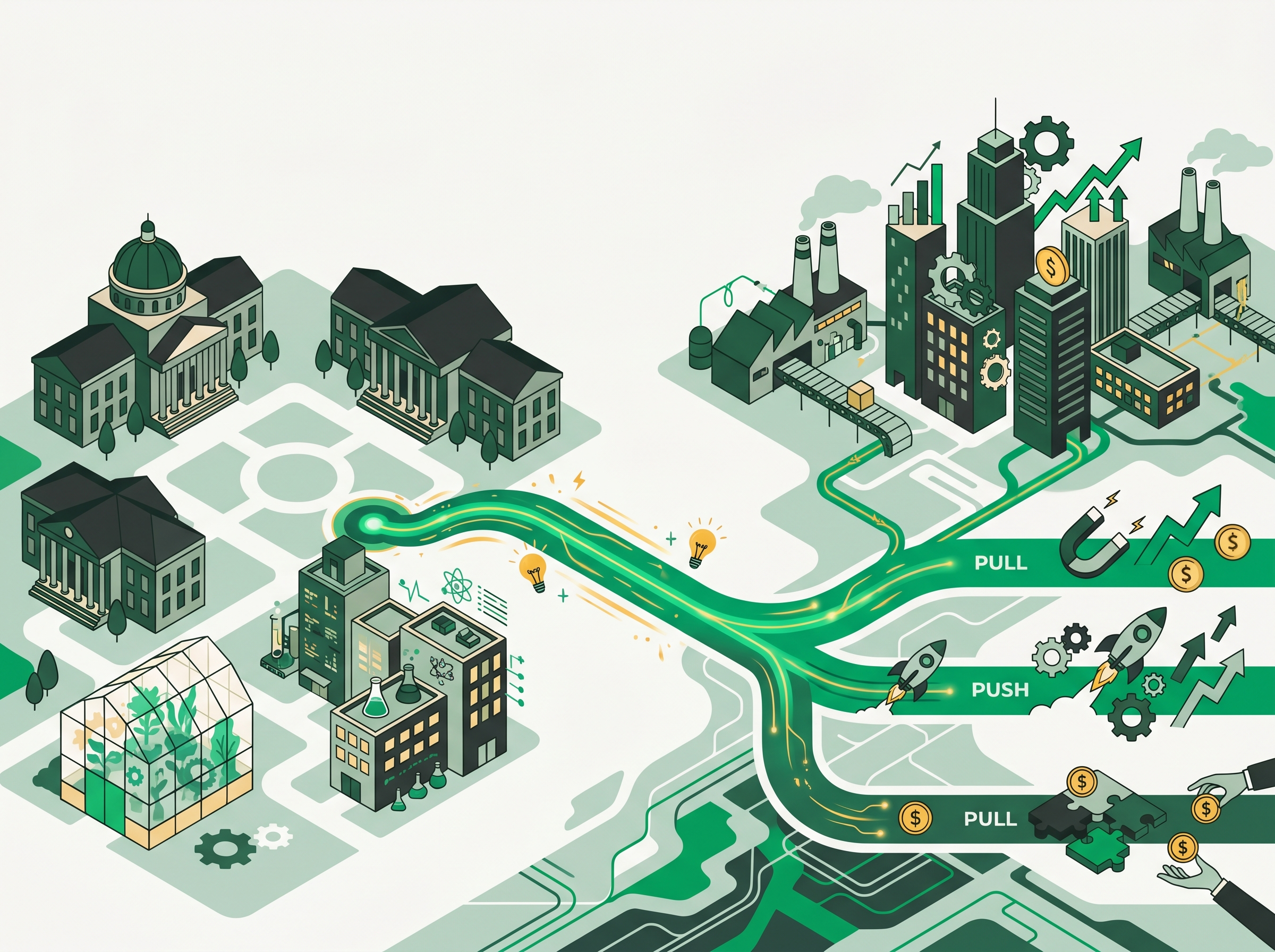
The TTO's upstream/downstream position in the commercialization ecosystem

Technology transfer offices occupy a position in the commercialization ecosystem that no other type of organization shares.

You see technologies when they're still raw. Before a startup exists to champion them. Before an industry partner has identified the application. Before anyone has done the translation work of turning a research finding into a market-facing value proposition. In every meaningful sense, you are upstream of everything else.

And you're also responsible for what happens downstream.

When a technology matures enough to attract a licensee, a partner, or a startup formation, the TTO is the one negotiating terms, structuring the deal, managing the faculty relationship, and tracking what happens to the IP once it leaves the lab. That's downstream work: commercialization strategy, market entry, deal execution.

This dual position creates challenges that neither startups nor private companies face. A startup typically has one technology and one commercial thesis. Its entire operation is oriented around a single outcome. A private R&D organization has a business unit structure, a product roadmap, and a sales function. Neither of these types of organizations is simultaneously responsible for pulling innovations out of a faculty base, protecting them legally, marketing them to an industry that doesn't always know they exist, and managing the commercial relationship once a deal closes, while processing a continuous incoming flow of new disclosures on a team of three to seven people.

That's the job.

And because there's no startup founder to serve as the commercial champion for each technology, the TTO has to fill that role by default. Which means the TTO has to learn the problem space, not just the IP. It has to articulate what the technology does in language a technical buyer or a corporate development team will understand in sixty seconds. It has to tell the differentiated story — what this approach does that alternatives don't, why the application matters, what a partner gains by engaging now rather than later.

This isn't a marketing function that gets bolted on. It's the core commercial responsibility of the office. And it requires infrastructure to execute at the scale a portfolio of 150 to 300 annual disclosures demands.

The rest of this guide is about building that infrastructure.

The Hidden Dependency

Federal funding as the hidden validation layer
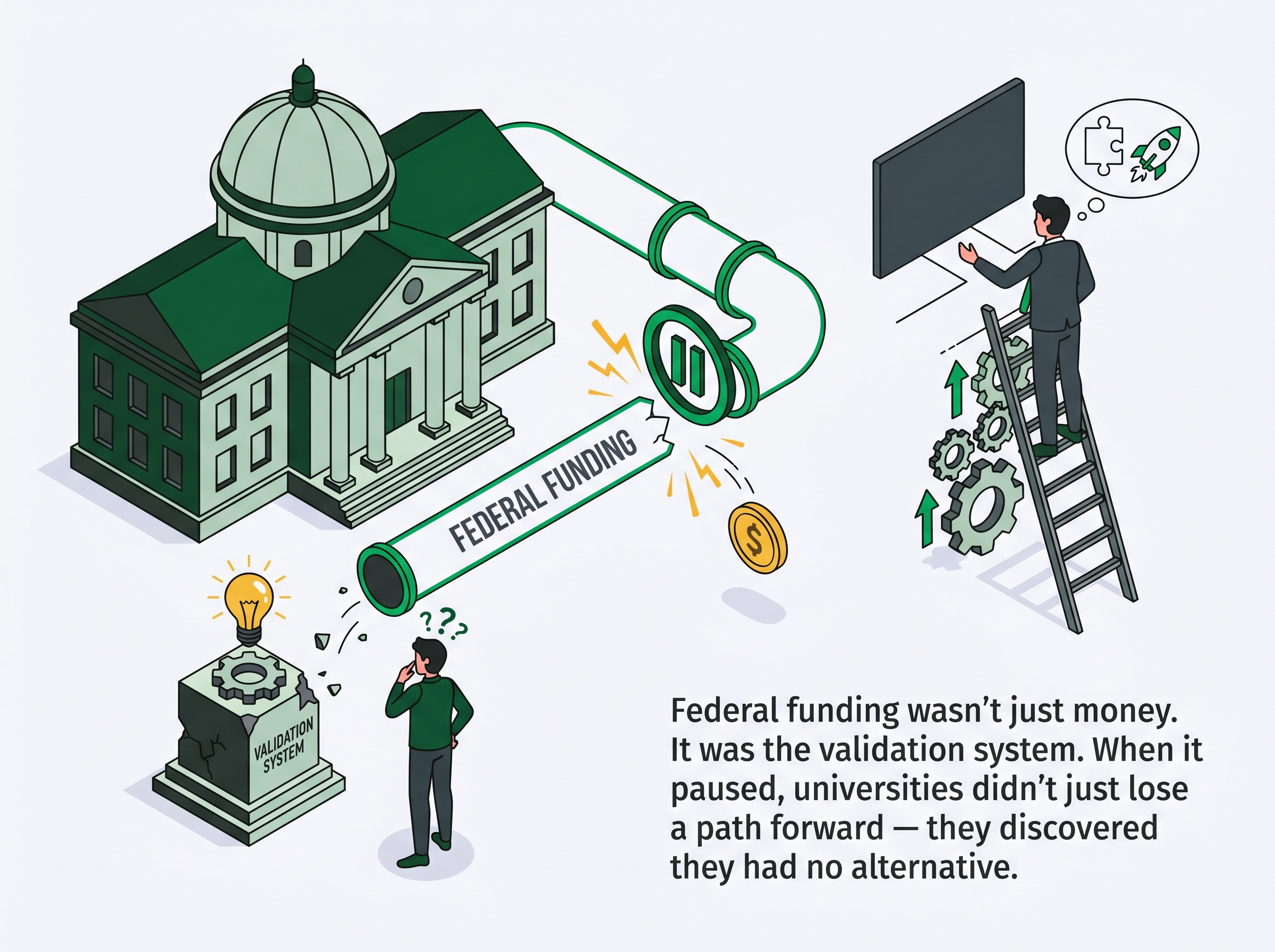
Federal funding was the validation system. When it paused, the whole architecture paused with it.

Here's the part that doesn't get said clearly enough: For universities, federal funding wasn't just money. It was two things at once — and we let both of them run on a single input.

The first was obvious: federal programs funded the research itself. They paid for the graduate students, the postdocs, the equipment, the lab time. For many university research programs — particularly in deeptech, hardware, advanced materials, and biomedical engineering — federal funding wasn't supplemental; it was foundational. The research pipeline depended on it.

The second was less visible but equally structural: federal funding served as the commercialization validation architecture for everything downstream. When a technology received federal funding, that award told the TTO which technologies had legs. It told potential licensees that something credible had vetted the science. It told corporate R&D teams that the technology was worth evaluating. It told investors that a government agency had de-risked the early development. It acted as a triage filter in a system where TTO staff had no other scalable way to prioritize a portfolio of hundreds of technologies with limited time and attention.

When the federal funding and SBIR lapse hit in 2025, universities didn't just lose a commercial path. They lost their research development infrastructure and their commercialization validation system at the same time. The double whammy.

The technology that would have received a Phase I award doesn't just miss the funding. It also misses the signal that would have told the TTO to prioritize it, the validation that would have attracted an industry partner's attention, the credibility that would have made a licensing conversation worth pursuing. Every downstream benefit of the award disappears.

The system did work — at least well enough for long enough that nobody felt compelled to build the redundant infrastructure that would have survived the failure.

The lesson isn't that federal funding is bad. Federal funding is essential, and its return is welcome. The lesson is this: a university that relies on federal funding to both produce and validate its technology commercialization has no commercial infrastructure of its own. And the next disruption — the next budget reconciliation, the next political transition, the next program restructuring — will expose that dependency again.

The offices that build their own commercialization infrastructure now are the ones that will be resilient during the next disruption.

The Acceleration-Fragility Paradox

The acceleration-fragility paradox
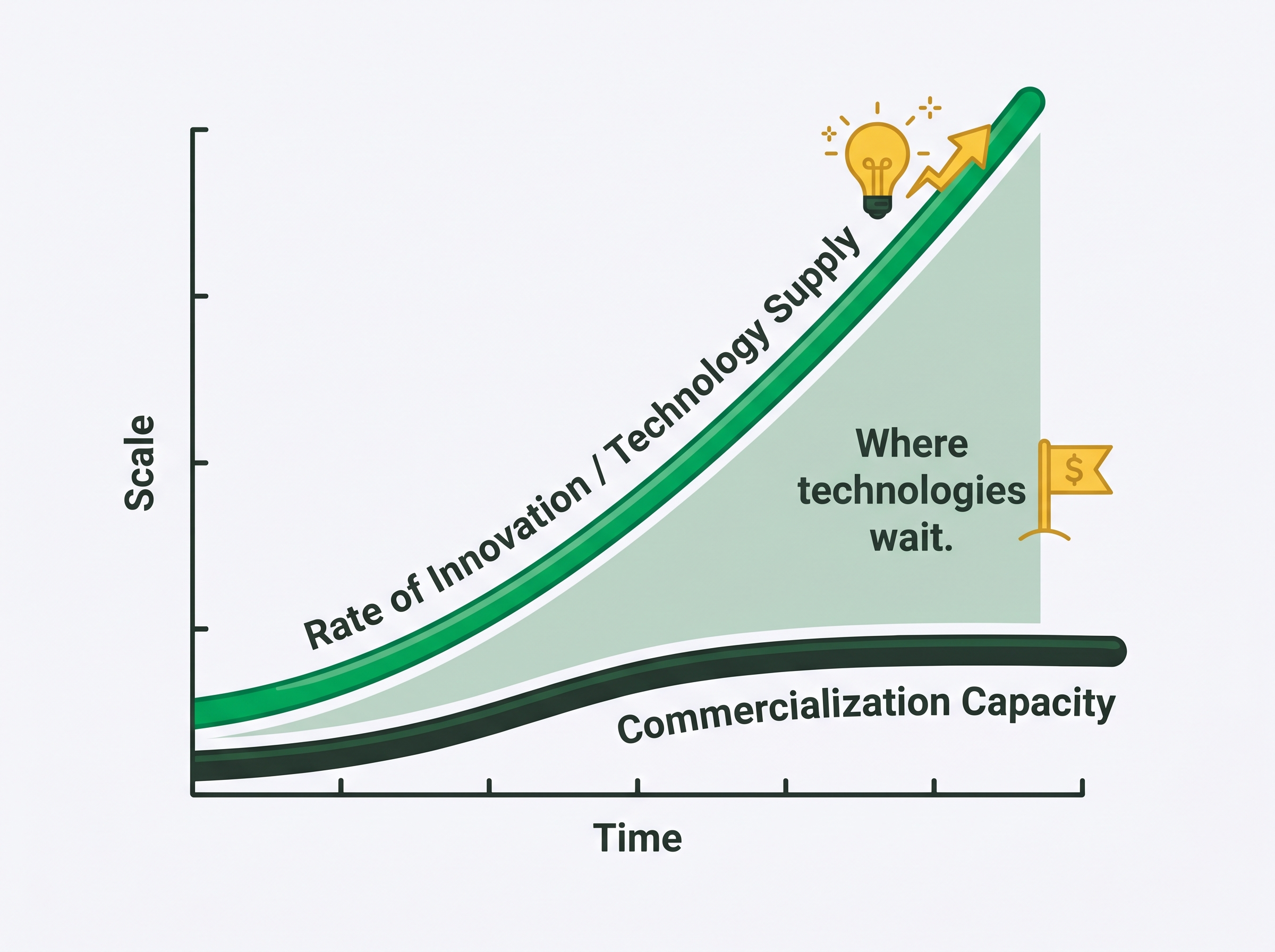
Innovation supply is accelerating. Commercialization capacity is not. The gap is where technologies wait.

The need for technological breakthroughs has never been higher. University labs are making significant strides in advanced materials, biotechnology, energy systems, photonics, and computing at an accelerating rate. AI infrastructure demands new power sources and new materials to run efficiently. Defense modernization creates urgent needs for sensing, communications, and propulsion. The research enterprise has rarely been more relevant to the market.

But the systems responsible for moving those innovations into the market haven't kept pace. Not even close.

The result is a growing mismatch. The supply of potentially transformative technology is accelerating. The capacity to translate it into market-ready opportunities is not. And the gap between those two lines is where TTO portfolio technologies go to wait — sometimes for years, sometimes until the market window closes entirely.

A Mandate, Not Just a Problem

Here's the part that matters most: this moment is not a crisis to survive. It's a mandate to change.

The status quo is no longer defensible. Not because it was wrong before. But because the pace of innovation, the fragility of federal funding, and the emergence of automation and AI tools have collectively moved the bar.

Universities are not short-order cooks. The expectation that faculty will redirect their work toward market priorities on a commercial timeline is neither realistic nor appropriate. The depth and independence of university research is precisely what makes it valuable.

But there is a meaningful difference between the research mission and the commercialization infrastructure. Universities can preserve everything that makes their research valuable while building dramatically better systems for moving it into the market. Better commercialization infrastructure produces more successful outcomes for researchers, which strengthens the research enterprise itself.

Automation and AI have moved much of this from optional to table stakes. The offices treating systematic commercialization infrastructure as optional are already behind.

The Push-Only Model

To understand why the system works the way it does, you have to understand the mental model behind it.

Most technology transfer follows a linear logic: Researcher discloses → TTO evaluates → Patent application filed → Technology marketed → Licensee found → Market reached.

That sequence feels intuitive. It's how most offices structure their workflow. And it produces a very specific set of activities: writing invention disclosure responses, filing patent applications, attending industry conferences, sending one-pagers to known contacts, posting technologies to database listing services, and waiting for inbound inquiries.

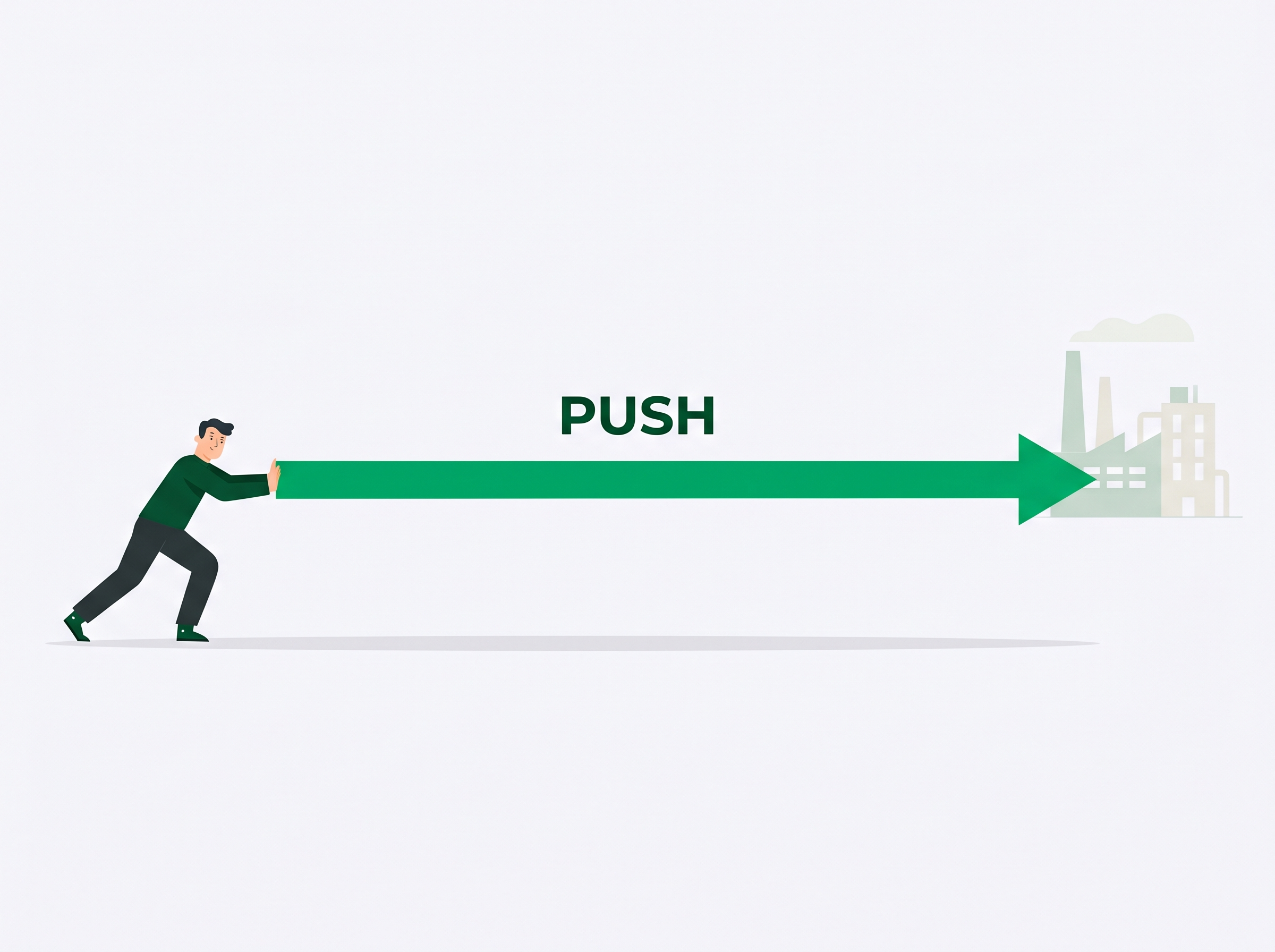
These are all push activities. They share a common characteristic: they require the office to go outward, to convince, to present, to ask for attention. And when each effort concludes, it leaves nothing behind. The conference ends. The email is sent or not. The database listing sits. Nothing compounds.

Push is not inherently wrong. Push is necessary. Every commercialization effort requires some form of it. The problem is when push is the only thing you have — and in university technology transfer, push is almost always the only model.

This pattern formed for understandable reasons. Tech transfer offices were built around IP protection, not demand generation. The core competency is legal and administrative: patents, agreements, compliance, faculty relations. Commercialization was an adjacent function added to the job description without adding the tools or training that would make it scalable.

The metrics reinforced it. Universities measure technology transfer by patents filed, licenses executed, and royalty revenue generated. Not by pipeline built, not by market awareness created, not by industry relationships in active development. The incentive structure optimizes for transactions, not infrastructure.

The Constraint Trap

The three-jaw constraint trap: money, time, personnel
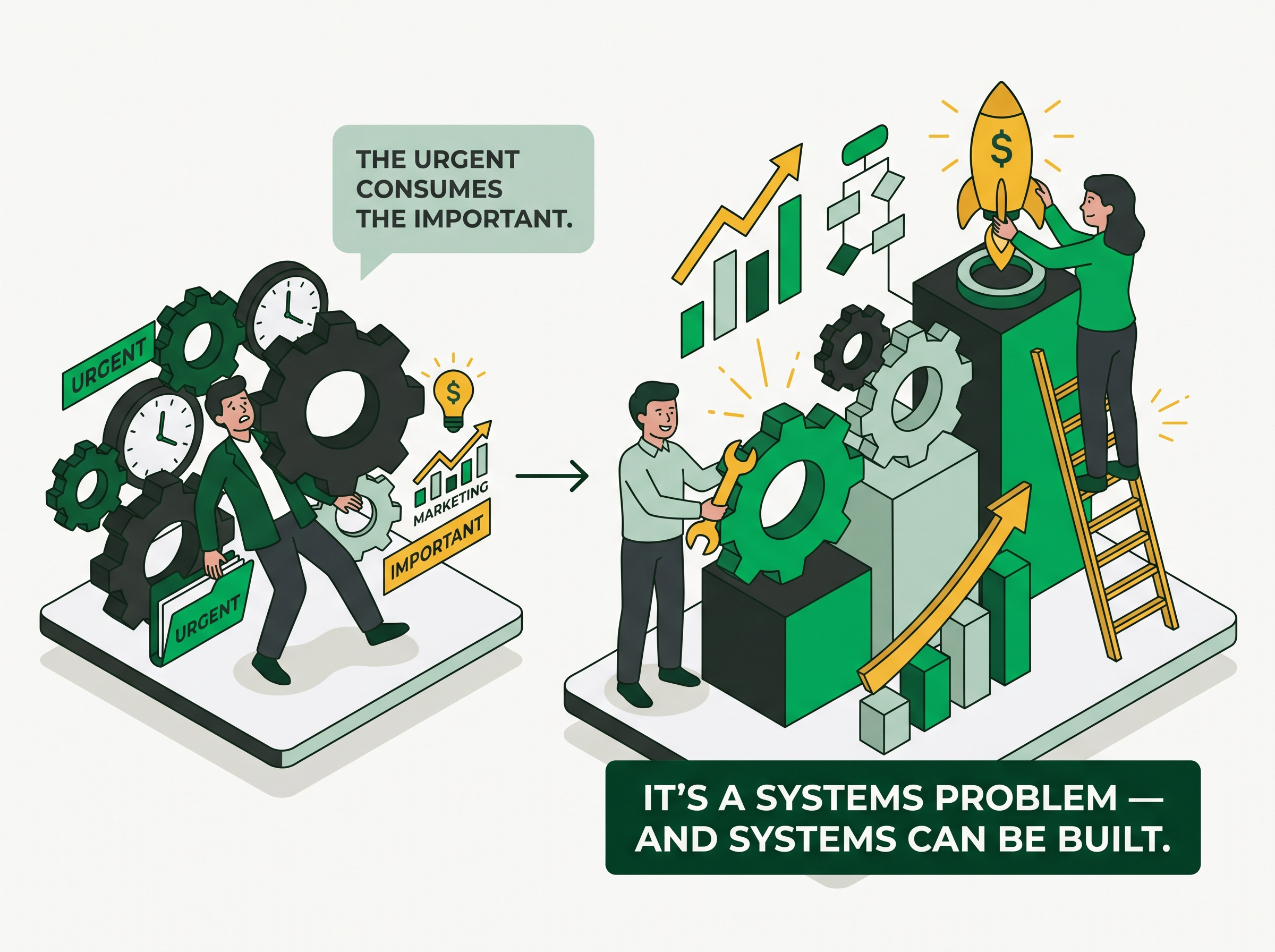
The urgent consumes the important, every cycle. This is a systems problem — and systems can be built.

Here's where the push-only model becomes genuinely dangerous — because in technology transfer, push-only doesn't just produce inefficiency. It produces a specific, predictable trap with three jaws.

Constraint 1: Money

Technology transfer offices operate with limited budgets and no discretionary development funding. This creates a constraint that goes beyond what most people imagine when they think about underfunded offices.

It's not just that there's no money for additional staff, for better tools, for marketing infrastructure. It's that there's no ability to fund the short-term research that would actually close deals.

Here's how this plays out: You have a promising technology. You've got an industry partner at the table. They're interested. They see the application. And then they ask what the next development phase looks like and who pays for it. Two semesters of characterization data. A postdoc. A specific test that the supplier needs before they'll commit to integration specifications. None of it is in anyone's budget.

The university can't fund it. The industry partner won't commit before the data exists. The TTO has no mechanism to bridge the gap. The window closes. The technology dies on the vine — not because it wasn't good enough, but because there was no infrastructure to carry it the last mile.

This is the worst feeling in the job. And it happens more than it should.

Constraint 2: Time

The bandwidth math in a technology transfer office never works.

A typical office will receive a disproportionate number of disclosures every year relative to the staff they have. A licensing manager may be the direct point of contact for 30 to 40 researchers simultaneously. That same person is also managing patent filings, negotiating license agreements, supporting startup formations, attending industry events, reporting to administration, and processing the next intake that arrived while they were doing everything else.

There is no time in this schedule for systematic market development. No time for building a content strategy, maintaining an outreach pipeline, developing partner relationships that aren't connected to an active deal, or analyzing which technologies in the portfolio are generating market signal.

The urgent consumes the important, every cycle. Something always loses. It's almost always marketing.

Constraint 3: Personnel — in Both Directions

The personnel constraint in technology transfer is two-sided, and both sides are structural rather than personal.

On the TTO side: the office doesn't have enough staff to execute everything the job requires. Interns process disclosures. A small team manages everything from IP strategy to industry outreach to startup formation to faculty relations. The expertise required to build commercialization infrastructure — content strategy, automated outreach, CRM, analytics, partner network management — is rarely present and rarely budgeted for.

On the faculty side: the researchers on whose work everything depends operate on their own timelines. Tenured faculty are among the most accomplished people in their fields. They are not always the most responsive participants in a process that requires timely input on disclosure forms, IP decisions, and licensing terms. If the department chair doesn't prioritize technology transfer, the incentive to engage is limited. If the TTO's process is slow or opaque, word spreads quickly.

The automation system that documents "we are waiting on the inventor, not the other way around" isn't just efficiency — it's institutional protection. It's the difference between being able to report accurately on where delays originate and absorbing blame for a process that was actually stalled at the source.

The Reframe — Pull-Push-Pull

The Pull-Push-Pull flywheel
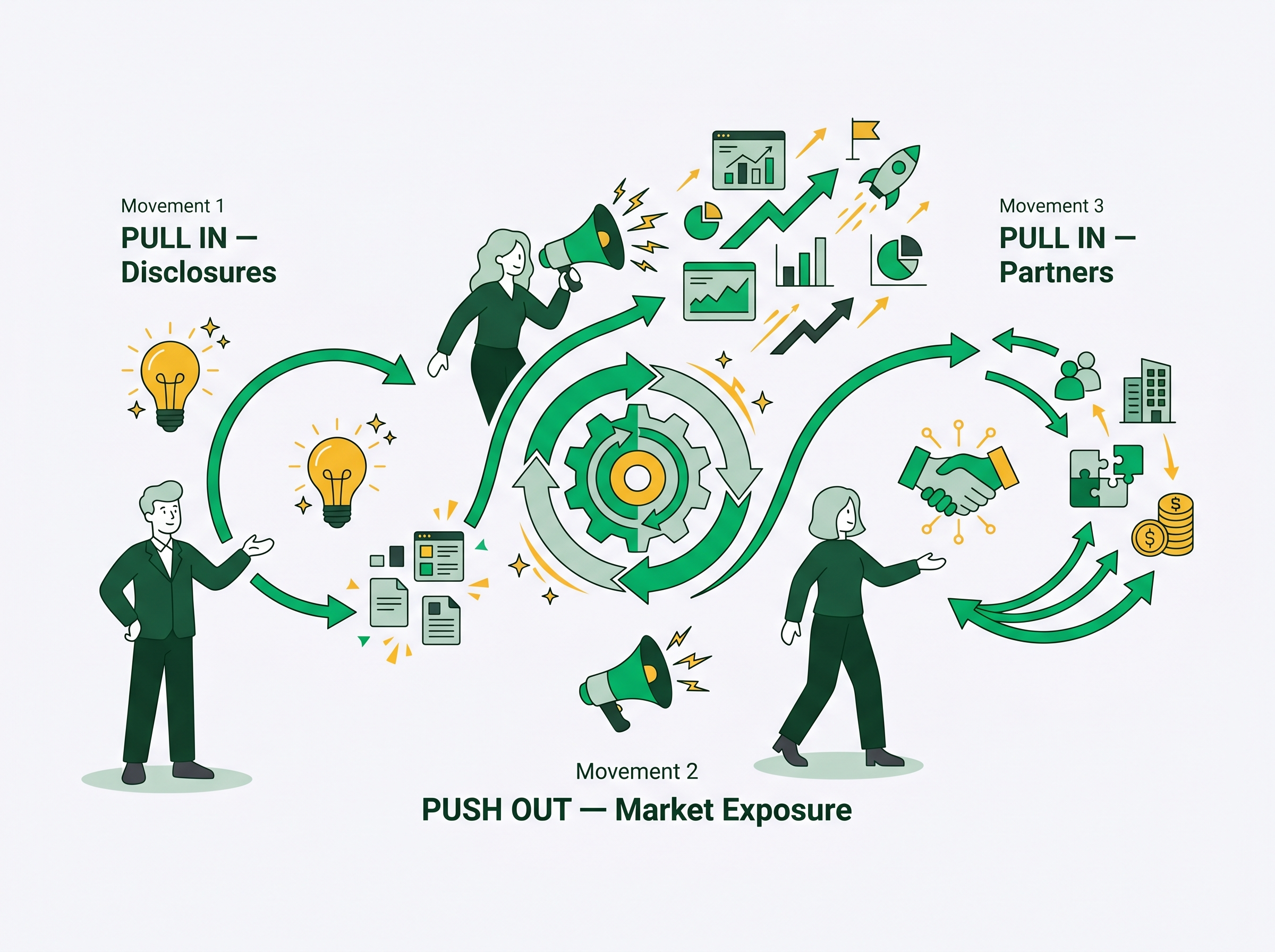
The Pull-Push-Pull flywheel: three movements that compound on each other.

So what's the alternative?

It's not to abandon push. Push matters. Conferences still matter. Industry relationships still matter. Direct outreach, licensing negotiations, database listings — all of it still matters.

But push alone is not enough. It never was. We just didn't feel the cost of that gap until the infrastructure supporting it started to fail.

The shift is to recognize that the problem has three dimensions — and to build three corresponding movements.

Movement 01

Pull-In: Disclosures

Before you can commercialize a technology, you have to know it exists — and before a researcher will tell you it exists, they have to believe disclosing is in their interest. The researcher engagement system builds that belief systematically, with compounding returns over time. It fills the pipeline.

Movement 02

Push-Out: Market Exposure

Once a technology enters the portfolio, it needs commercial surface area. The Fleet Model is a systematic, scalable pipeline that moves technologies from disclosure to market engagement without requiring full manual attention for every disclosure. It handles the volume.

Movement 03

Pull-In: Partners

A curated partner network — organized by technology domain and commercial role, maintained with consistent content and outreach — means every new technology enters the portfolio into a warm environment. Movement 3 replaces the cold start. Every new technology launches into a relationship infrastructure that was built before it arrived.

And they compound on each other. Better disclosures from Movement 1 produce better portfolio quality for Movement 2. Market signal from Movement 2 tells you which technologies to escalate and how to position them for Movement 3. Licensing successes from Movement 3 produce stories that feed back into Movement 1 — researchers hear about colleagues whose technologies found homes, and disclosure rates improve. The flywheel turns.

The Compounding Effect

Each movement has standalone value. Together, they compound. The flywheel doesn't require all three to start turning — but it only reaches full speed when all three are operating.

The Researcher Engagement System

The first question any TTO commercialization system has to answer is the one that precedes everything else: how do we make sure we know about the technologies we should be commercializing?

The answer is not a disclosure form. It's not a workshop. It's not an annual IP awareness email that goes out to all faculty in September and is forgotten by October.

Those things are necessary. They are not sufficient. And they share a fatal flaw: they don't compound. Each year, a new cohort of faculty arrives. The education restarts. The awareness built last year doesn't carry forward. The trust established with one department doesn't automatically transfer to another. Nothing accumulates.

Why Researchers Don't Disclose

To build the right system, you have to understand the right problem. Researchers avoid disclosure for reasons that are deeply rational given their incentives.

Academic careers are built on publication and peer recognition — not commercialization. Filing for IP protection can delay or complicate publication, which is career-critical. The disclosure process, if it's slow or opaque, feels like a bureaucratic risk with uncertain upside. And if a colleague had a bad experience — a missed filing deadline, a confused response, a technology that went nowhere after disclosure — that story travels faster than any success story.

The reputation of the TTO compounds in both directions. Make it easy and valuable to disclose, and researchers start coming before they publish, asking whether something might be worth protecting. Make it slow and opaque, and word spreads. A single visible failure can suppress disclosure rates across an entire department for years.

What the System Looks Like

A researcher engagement system isn't a one-time training. It's a communication cadence, a content infrastructure, and a set of lightweight digital tools that work continuously — building the TTO's reputation as a resource, not a bureaucracy.

A consistent communication cadence means regular, lightweight contact with the faculty base. Not mass emails about filing procedures — researcher-centric content: stories of technologies that found licensees, explanations of what commercial potential looks like in a given field, transparent updates about what the office is actively working on. Trust-building at scale. It doesn't require a dedicated communications team. It requires a system.

A frictionless disclosure process means clear forms, rapid acknowledgment, and visible status updates. When the office is waiting on something from the inventor, the system sends a reminder and documents the waiting state. That documentation is institutional protection — a clear record that the delay originated with the inventor, not the office.

Reputation recovery mechanisms matter because failures will happen. The question is whether the TTO has proactive communication infrastructure to address them — or whether a bad experience at the departmental level quietly suppresses disclosure rates for years without anyone knowing why.

Every researcher who has a smooth, responsive experience tells colleagues. Every positive disclosure outcome — especially ones the office can share publicly — reinforces that disclosure is worth doing. This is Movement 1. It fills the pipeline.

A Field Note

Herding the Cats That Are Tenured Faculty

Tenured faculty can sometimes be the most frustrating group of people to get to take timely action. You see, they are busy. They have classes to teach. Grad students to manage. Research to conduct. And you, well — you don't have any of that to do. You are just the person that's annoyingly asking them to do something. You are the one asking them to confine their genius to a mere invention disclosure form. And for what? A patent? Something that they may or may not even understand the value of in the moment.

But you can't just omit this step. You need their insight and buy-in or you can't process the disclosure. In this sense, they are definitely like herding cats. Except they are all Garfield — with a genius intellect — and when you think they'd be motivated by lasagna, you realize that depending on the day they may want to ponder the existence of lasagna altogether. Until they need something urgently. And then lasagna sounds amazing.

So what do you do?

The best thing you can do is make sure the stoppage in this process always lies with them and never the office. And you also have to make it incredibly easy for you to pick up and put back down — by tracking the disclosure's place in the pipeline. The steps in between can — and should be — automated.

So instead of asking the professors for their precious time in between bossing around grad students and dealing with undergrads, you're simply reminding them their plate of lasagna is ready for them when they want it.

The Fleet Model — Commercialization at Scale

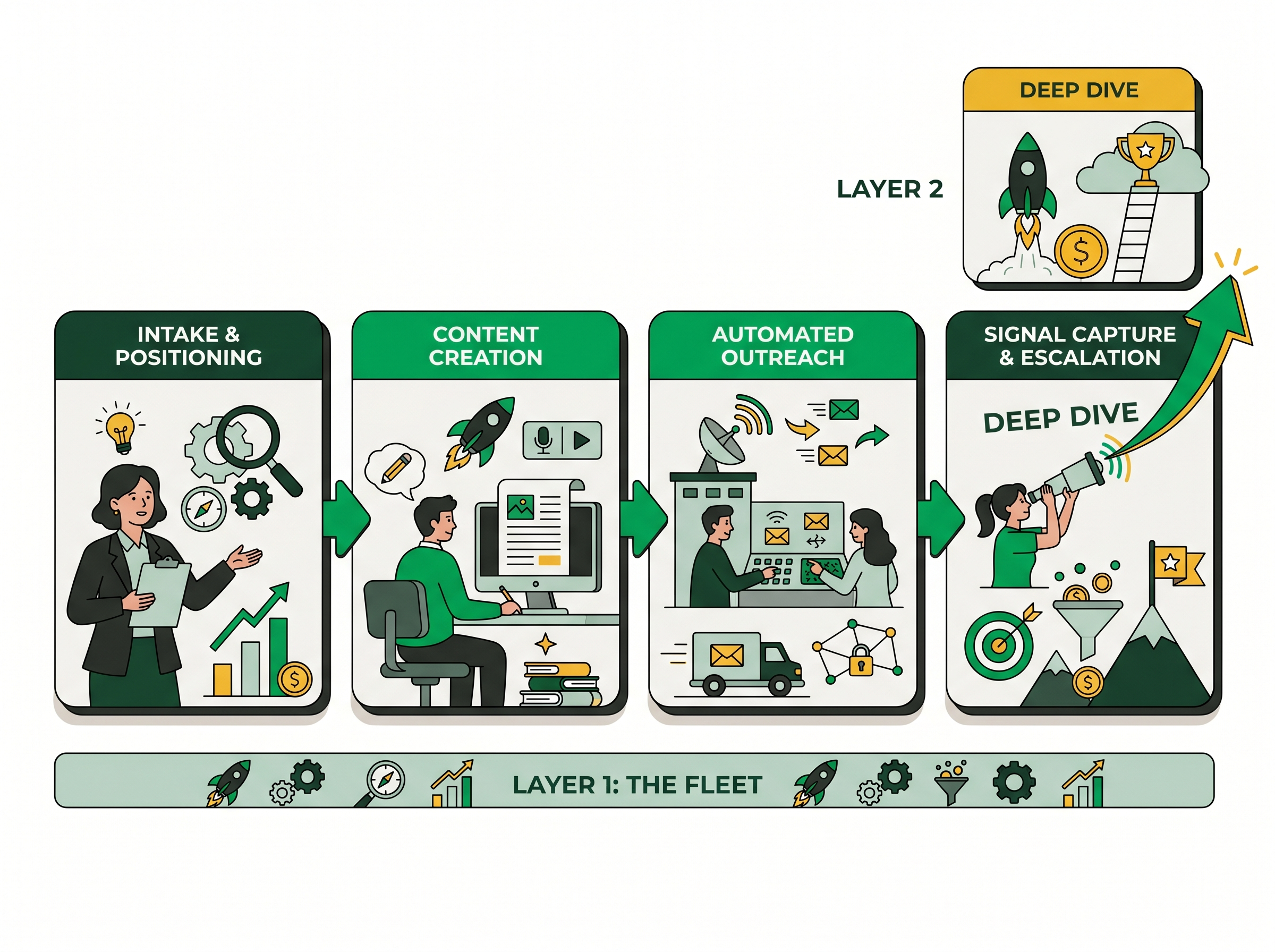
The Fleet Model: four-stage pipeline
The Fleet Model: four stages from intake to signal, with escalation to Deep Dive.

Here's where the technology transfer challenge diverges fundamentally from the startup challenge — and where the solution has to diverge with it.

A startup is a single vehicle. One technology, one market thesis, one commercialization path. The goal is to build the most powerful engine possible for that one innovation.

A technology transfer office is a fleet.

You have dozens, sometimes hundreds, of technologies at various stages of readiness. Some are early-stage research findings with potential commercial applications that haven't been mapped yet. Some are mature prototypes with interested partners who need one more development milestone. Some are sitting on granted patents with no active commercial conversation.

You cannot build a custom commercialization engine for every disclosure. With a licensing manager responsible for so many researchers and a large active docket, the math doesn't work. The resources don't exist. The timeline doesn't permit it.

What you need is a fleet of lightweight, standardized vehicles designed to move technologies from disclosure to market exposure efficiently, with a system that escalates the ones generating signal into deeper engagement.

The Two-Layer System

Layer 1 is the fleet itself. Every disclosed technology gets a standardized commercialization vehicle: clear positioning, market-facing content, and targeted outreach that puts it in front of relevant industry contacts. This doesn't require hours of custom strategy per technology. It requires a repeatable system that handles the common work — the 80% that's structurally similar across all technologies — so your team can focus on the 20% that requires human judgment.

Layer 2 is the Deep Dive. Technologies that generate meaningful market signal — inbound inquiries, meeting requests, content downloads, direct replies to outreach — get escalated to more intensive engagement. Targeted outreach. Custom positioning. Active relationship development. The work that licensing managers are actually trained to do, focused on the technologies the market has already signaled are worth prioritizing.

This isn't just more efficient. It's smarter. Instead of relying on internal judgment to guess which technologies deserve attention, you let the market tell you. The fleet generates signal. The signal drives escalation. Prioritization becomes data-driven, not committee-driven.

The Pipeline in Practice

Stage 1: Intake and Positioning. When a disclosure arrives, it enters a structured intake process. The goal is translation: what problem does this solve, for whom, and why is this approach better than alternatives? A standardized positioning template ensures consistency and enables everything that follows.

Stage 2: Content Creation. Once positioned, the technology becomes market-facing content — not a patent abstract or a technical paper summary. A clear, compelling technology profile written for the industry professional who needs to understand the commercial case in sixty seconds.

Stage 3: Automated Outreach. Each positioned, content-backed technology enters an outreach system that identifies and reaches relevant industry contacts: corporate development teams, technical buyers, industry practitioners, startup founders looking for platform technologies. This isn't mass email. It's targeted, problem-led communication. The system handles the volume. The team handles the conversations that result.

Stage 4: Signal Capture and Escalation. As outreach runs, the system captures market signals: opens, clicks, replies, meeting requests, content downloads. Technologies generating strong signals move to the Deep Dive. Technologies with weak signals get repositioned, retargeted, or returned to the portfolio with data about what didn't resonate. The pipeline makes the entire portfolio smarter over time.

A Note on Market-Facing Infrastructure

Getting technologies in front of the right industry audience requires a dedicated market-facing presence — not the university's main website, but a platform designed for industry: organized by problem and application, with clear pathways for interested parties to engage. Many TTOs don't control their own digital infrastructure. That constraint is real and solvable. How Catalyzing Concepts addresses it directly is covered in the final section.

The Partner Network — Building the Warm Room

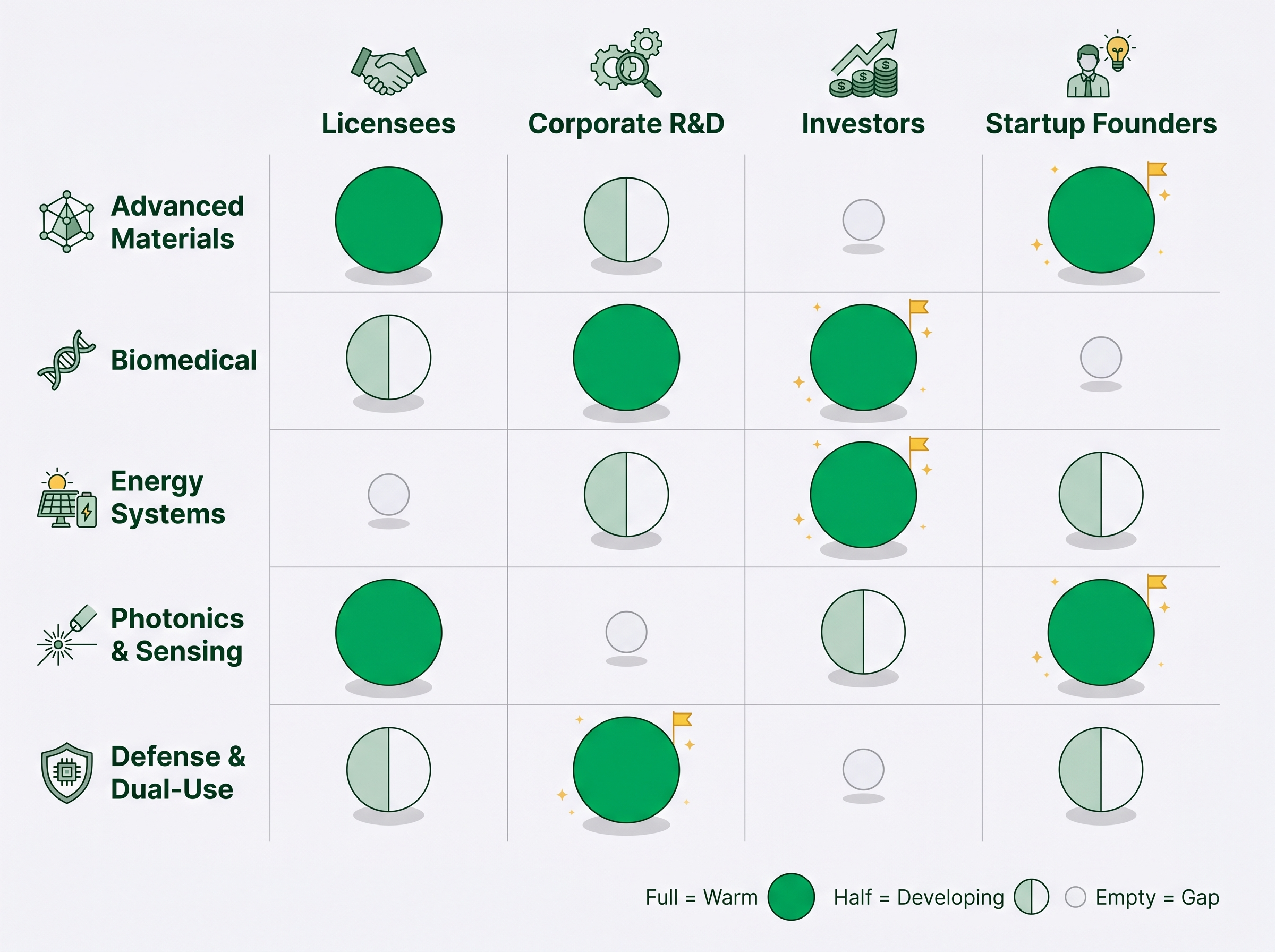
The curated partner network organized by domain and role
The curated partner network: organized by commercial role and technology domain.

Every time a TTO has a new technology ready for commercial engagement, the same thing happens.

Staff reach out to whoever they know. They check the contact list. They send a note to the industry advisory board. They think about which conference might be coming up where the right people will be in the room. They start from zero — or close to it.

This is point-in-time outreach. It is necessary but not sufficient. And it has a structural flaw that compounds over time: every technology starts the same conversation. Every outreach cycle rebuilds the same relationships. The work never accumulates into anything that makes the next technology easier to place than the last one.

The alternative is a curated partner network.

What It Is

A curated partner network is not a contact list or a database that staff members update when they remember to. It is structured commercialization infrastructure — organized by commercial function and technology domain, actively maintained with consistent content and outreach, and built to persist regardless of personnel changes.

The network is organized along two dimensions.

By commercial role: licensees who want to develop and sell technologies; corporate R&D partners who want sponsored research or early access to IP; investors looking for deeptech opportunities; startup founders seeking platform technologies to build on; pilot partners who can provide validation data and real-world testing environments.

By technology domain: organized around the TTO's actual portfolio — the specific application areas, industry verticals, and problem spaces where the office has recurring technologies. Not generic categories, but the actual domains where your researchers are producing commercial-potential work.

Members of the curated partner network receive content: research updates, technology announcements when new disclosures enter the portfolio, problem-framing articles that connect academic work to industry applications. Not sales content — relationship content. The kind that makes an industry professional glad to be on the list.

When a new technology enters the portfolio, the TTO doesn't start from zero. It activates the relevant segment of the network. The first conversation starts warm.

How It Differs From a Personal Network

The most common objection is "we already have an industry network." And the answer is: yes, and it typically belongs to whoever happens to be on staff right now. Or maybe you have a spreadsheet on the shared drive. You may even have a CRM of some sort set up. My experience is that most offices do not.

Which leaves most relying on a personal network that depends on who is in the role. It doesn't transfer with the portfolio when a licensing manager leaves. It doesn't scale across technologies that fall outside the manager's specific domain. It doesn't compound across years the way institutional infrastructure does.

How It Compounds

A corporate R&D team that came into the network because of interest in a photonics disclosure two years ago is now familiar with your office, has read eighteen months of research updates, and has already formed a positive impression of the TTO's professionalism and responsiveness. When a new optics-adjacent technology enters the portfolio, that team gets an announcement. They've been warmed for two years. The first conversation is not a cold introduction.

The compounding effect doesn't happen immediately. It takes twelve to eighteen months of consistent engagement before a curated partner network reaches critical mass. But the office that starts building now has a structural advantage over every office waiting for the next technology to justify the effort.

Every technology added to the portfolio benefits from the network built for every previous technology. That's the compounding. That's why this movement is worth building before you feel like you need it.

What Pull Actually Looks Like for a TTO

This is where most frameworks lose people. The concept makes sense in theory. The objections come when people try to imagine what it looks like inside a university technology transfer office on a Tuesday afternoon when there are six things that need attention before 5pm.

OBJECTION 01

"We're Not a Marketing Department"

This is the most common objection. And it's based on a misunderstanding of what pull actually is in this context.

Pull isn't marketing in the traditional sense. It's commercialization infrastructure at scale. It's making sure that the technologies your researchers have spent years developing are visible to the people who might license them, partner on them, or build companies around them — without requiring a staff member to personally reach each of those people through manual effort.

Right now, most of that visibility depends on the licensing manager's personal network and the conference circuit. That's not a system. That's a constraint dressed up as a process. Pull replaces the constraint with infrastructure that works in the background.

OBJECTION 02

"Every Technology Is Different"

True. And the fleet model accounts for this. The standardized pipeline handles the 80% that's common across all technologies: positioning framework, content structure, outreach mechanics, signal tracking. The 20% that's genuinely unique — the specific technical differentiation, the unusual application context, the non-standard licensing structure — gets handled by your team's expertise.

You don't need a bespoke commercialization strategy for every disclosure. You need a system that handles the common work and frees your team to focus on the uncommon work: the relationship-building, the negotiation, the judgment calls that actually require a licensed professional.

OBJECTION 03

"We Don't Have the Resources"

This is the most honest objection. And it deserves an honest answer.

Most TTOs are running lean. The team is managing disclosures, filing patents, negotiating licenses, supporting startups, reporting to administration, and attending every industry event they can. Adding "build a commercialization infrastructure" to that list isn't a strategy. It's a recipe for burnout.

The solution isn't to ask overwhelmed TTO staff to become marketers and systems architects. It's to build the infrastructure for them — or alongside them — in a way that's fast, structured, and produces results before it consumes months of bandwidth. That's what Catalyzing Concepts is built to do.

OBJECTION 04

"We Don't Control Our Website"

University IT governance and branding restrictions are real constraints — and they're exactly why the commercialization infrastructure we build operates entirely outside those channels. A branded subdomain, or an anonymously hosted platform, operated independently of university IT. More on this in the next section.

OBJECTION 05

"We've Tried This Before"

I'd be surprised if you hadn't. But be honest: were you starting from scratch each time? Did you have a system where a new contact on one technology project could become a warm lead on another? Was your outreach organized by technology area, readiness level, and job role — or was it whoever you happened to know?

How consistent were you? Did you keep going when you didn't see immediate results? Did you have a way to track your metrics? Was the system built for the full end-to-end process — or just the first conversation?

Most TTOs have tried outreach. Few have tried a system. There's a difference between activity and infrastructure. One produces occasional wins. The other compounds.

The Three Capabilities

Understanding the Pull-Push-Pull framework is the diagnosis. Building it is the prescription. And the prescription comes down to three specific operational capabilities that every TTO should have — and that most currently lack.

Capability 01

Disclosure Automation

A functional disclosure intake process has two jobs. It processes information efficiently. And it maintains the relationship with the inventor through every stage of the process.

Most TTO disclosure systems do the first job passably and the second job poorly. The disclosure arrives. Someone reviews it. If more information is needed from the inventor, a request goes out. The process stalls — waiting for a response that may arrive in three days or three months, with no systematic reminder and no documentation of where the delay originated.

Automating the disclosure process means building a system that handles the mechanical work — acknowledgment, status updates, reminder sequences, documentation — so that the licensing manager can focus on the judgment work: evaluating commercial potential, advising on IP strategy, managing the faculty relationship.

The automation system should acknowledge every disclosure within a defined timeframe, communicate status updates at defined intervals, send automated reminders when waiting on inventor action, and document those waiting states clearly.

Two additional benefits matter as much as the efficiency: the documentation allows the licensing associate to report accurately when delays originate with inventors rather than the office. And systematic, responsive communication builds the faculty trust that produces better disclosure quality over time.

Capability 02

Active Marketing

The second capability is an outward-facing mechanism that actively puts technologies in front of relevant industry contacts — without waiting for those contacts to find the technology on their own.

This means a market-facing digital presence for the technology portfolio. Not the university's main website. A platform designed for industry audiences, presenting technologies by the problem they solve and the differentiated approach they take, with clear pathways for interested parties to request more information or initiate a conversation.

It also means an outreach infrastructure that identifies relevant industry contacts for each technology and reaches them with targeted, problem-led communication. Not mass email. Personalized outreach to people who have the problem the technology solves.

And it means a content strategy that maintains the TTO's visibility in relevant industry communities between disclosure announcements — research updates, technology spotlights, problem-framing articles that connect academic work to industry applications. When a new technology enters the portfolio, the relevant audience has already been primed.

Capability 03

Commercialization Management

The third capability is a standardized framework for managing the commercialization process from the moment a technology generates serious market signal to the moment a deal closes.

Commercialization paths for university technologies fall into three categories: option agreements, license deals, and startup formations. Each has a different structure, different negotiating dynamics, and different expectations on both sides. Most TTOs handle each one ad hoc, rebuilding the process each time.

A standardized commercialization management system maps the process for each vehicle type: what stages it moves through, what information is needed at each stage, what the standard terms look like, and what the timeline should be. Standardization doesn't mean inflexibility. It means having a professional starting point that doesn't require rebuilding from scratch for every deal.

Technologies that have generated signal through Movement 2 enter Movement 3 with data. The office knows which industries responded, which messages resonated, and which potential partners have been engaging with the content. That intelligence shapes the commercialization strategy for each technology that reaches the Deep Dive level.

The Build Checklist

You don't need a year-long initiative to build a functional Pull-Push-Pull system. You need to know what to build, in what order, and what "done" looks like for each component. The following checklists are designed to be used as working tools — not aspirational frameworks. Each item represents a concrete action or decision with a defined output.

Part 1: Disclosure Digitization and Automation

  • Define the disclosure intake stages and create status labels: Received, Under Review, Awaiting Inventor Response, IP Decision Pending, Active Marketing, Archived
  • Build an auto-acknowledgment that goes to inventors within 48 hours of disclosure submission
  • Create a disclosure intake form capturing: technology description in lay terms, potential applications, awareness of prior art, interested parties known to the inventor, faculty preferences on commercialization path
  • Set up automated reminder sequences for inventor action items, with documentation of waiting states and timestamps
  • Build a status update template that goes to inventors at defined intervals — every 30 days while disclosure is under active review
  • Create an internal dashboard showing every active disclosure, its current stage, who owns it, and what action is pending
  • Define escalation criteria: what triggers an IP filing recommendation, what triggers active marketing, what triggers an archive decision
  • Establish a process for communicating negative decisions to inventors clearly and quickly — the ongoing relationship with the researcher matters beyond any single technology
  • Audit the process end-to-end from the faculty member's perspective: is it as easy as it needs to be?

Part 2: Industry Engagement

  • Audit the current technology portfolio and identify 10 to 15 technologies suitable for a first outreach cohort — mix of stages, industries, and readiness levels
  • Write a positioning document for each technology in the cohort: problem statement, non-technical technology description, differentiated approach, target application and audience, development stage
  • Decide on market-facing digital infrastructure: branded subdomain, anonymously hosted platform, or both
  • Build or commission a technology profile page for each technology in the cohort: value proposition, application context, differentiated approach, clear pathway for interested parties to request more information
  • Identify target audiences for each technology: which industries, which roles, which company profiles
  • Build or source a contact database for the first outreach cycle
  • Create outreach sequence templates: initial outreach, follow-up, information request response
  • Configure and test the outreach system before launching to market
  • Define signal metrics: what counts as meaningful signal and what triggers escalation to a Deep Dive conversation
  • Set up a signal tracking system and assign ownership for reviewing signals on a defined cadence
  • Begin building the curated partner network: organize existing contacts by domain and commercial role, identify gaps, begin outreach to build the network independent of any active technology

What Comes Next

If you've read this far, you're probably in one of two places. Either you're seeing your own office in these pages — the funding dependency, the push-only model, the constraint trap, the disclosures that deserved better, the market windows that closed — and you're thinking about what needs to change. Or you already knew something was off, and now you have a framework for understanding why.

Either way, the path forward comes down to a practical question: what do you want to build, and how do you want to build it?

How Catalyzing Concepts Works With TTOs

Catalyzing Concepts offers four specific services for technology transfer offices. They can be engaged individually based on where the gap is greatest or combined into a defined retainer scope.

Infrastructure Setup. We design and build the Pull-Push-Pull infrastructure for your office: the disclosure automation system, the market-facing digital presence, and the outreach pipeline. This includes technology positioning for an initial cohort, configuration of the outreach system, and setup of the signal tracking and escalation process. Your team is trained to operate it before we hand it over.

Hosting and Maintenance. Many TTOs can't build or manage a market-facing digital presence through their own channels — because of IT governance, institutional branding restrictions, or a lack of internal bandwidth. We solve this directly. We build and operate a branded subdomain or an anonymously hosted platform on your behalf: a professional, industry-facing presence for your technology portfolio that operates entirely outside university IT. The TTO decides how visible it wants to be — institutional branding or anonymous-by-default, with interested parties introduced to the office after they engage. We maintain the platform, manage the outreach pipeline, and keep the partner network active. Your team stays focused on the work that requires a licensed professional.

Active Outreach. We manage the outreach for your technology portfolio — identifying relevant industry contacts, running targeted outreach sequences, capturing and reporting signal, and escalating high-signal technologies for your team to engage directly. This is not a marketing campaign. It's a systematic commercialization function operating on your behalf.

Commercialization Planning and Roadmapping. For individual technologies that have reached the Deep Dive level — generating meaningful market signal and ready for active commercial development — we provide commercialization planning: market positioning, commercialization path selection, partner identification, deal structure guidance, and ongoing strategic support through the licensing or startup formation process.

Where to Start

You don't have to build all three movements at once. Start where the pain is greatest.

If disclosure quality is the bottleneck, start with the researcher engagement system. Build the communication cadence. Get the faculty trust infrastructure working before you invest in the outreach pipeline.

If the portfolio is strong but technologies are sitting without market engagement, start with the fleet. Position ten to fifteen technologies, run the first outreach cycle, capture the first signal. The infrastructure will be ready for the next cohort before the first one completes.

If you have a functional fleet but keep running into cold-start problems — every new technology requires building relationships from zero — start with the partner network. Begin organizing existing contacts by domain and commercial role. Establish the content cadence. The network compounds from day one.

The Pull-Push-Pull engine works best when all three movements are operating. But each movement has standalone value. And the quickest way to build the full engine is to start with the movement that addresses the most acute constraint.

Push technology and products forward. Pull in funding and customers. Build the system around the Why and the differentiating What. Everything else acts as a catalyst to that.

Ready to build? catalyzingconcepts.com  |  bb@bhbickerstaff.com

The playbook is yours. Choose how you want to build.

Everything below this line is the working toolkit — positioning templates, disclosure checklists, industry engagement checklists, and partner network taxonomy. Pick the path that fits where your office is today.

Full Build · 4–6 Weeks

Infrastructure Setup

We design and build the Pull-Push-Pull infrastructure for your office: the disclosure automation system, the market-facing digital presence, and the outreach pipeline. Your team is trained to operate it before we hand it over.

This includes technology positioning for an initial cohort, configuration of the outreach system, and setup of signal tracking and escalation.

Reserve Your Build →
Managed Service

We Run It For You

We build and operate your market-facing platform, manage the outreach pipeline, and keep the partner network active. Your team stays focused on the work that requires a licensed professional.

Start with a short call to assess where the office is and what the highest-leverage starting point looks like.

Schedule a Call →

Also available: Active Outreach (managed outreach for your technology portfolio) and Commercialization Planning & Roadmapping (for individual technologies at the Deep Dive level). More at catalyzingconcepts.com.

Playbook A

Technology Positioning Template

Complete the following for each technology before it enters the outreach system. The goal is translation — not evaluation. The market evaluates. This template ensures the technology is presented in language the market can understand.

What specific problem does this technology solve? Write it from the perspective of the industry professional who has the problem, not the researcher who solved it.

How is this problem currently being addressed? What are the limitations of existing solutions?

What does this technology do? Describe it in language a technical-but-non-specialist reader can understand in 60 seconds. No jargon. No TRL numbers.

What does this technology do that alternatives don't? Be specific about performance, cost, scalability, materials, or process advantages.

What is the most compelling near-term commercial application? Who would license or deploy this first?

Who are the industry professionals most likely to care about this? List by role and sector.

What TRL is the technology at? What development milestone would meaningfully de-risk it for a commercial partner?

Patent pending, granted, or trade secret? Any licensing encumbrances?

Name, department, preferred contact method.

Does the inventor have preferences on commercialization path — licensing to an existing company, startup formation, sponsored research? Any known restrictions?

Playbook B

Disclosure Automation Checklist

System components to build or configure for a functional automated disclosure process.

  • Disclosure intake form: digital, accessible, designed for clarity over completeness
  • Auto-acknowledgment communication within 48 hours, personalized to the inventor
  • Internal routing to the responsible licensing manager with clear ownership
  • Status tracking system with defined stage labels visible to all TTO staff
  • Inventor-facing status update template on a 30-day communication cadence
  • Automated reminder sequences for inventor action items: 3-day, 10-day, 30-day
  • Waiting state documentation: timestamps, action required, responsible party clearly identified
  • Internal escalation triggers: what moves a disclosure to IP filing recommendation, active marketing, or archive
  • Inventor notification templates for each major decision point, written clearly and without jargon
  • Portfolio dashboard accessible to all TTO staff showing stage, ownership, and pending action for every active disclosure
  • End-to-end process walkthrough from the faculty member's perspective — at least once per year
Playbook C

Industry Engagement Checklist

Infrastructure to build and verify before the first outreach cycle launches.

  • Decision made on digital presence approach: branded subdomain, anonymously hosted platform, or both
  • Technology profile template built and tested for readability with a non-technical reader
  • Positioning complete for initial cohort of 10 to 15 technologies
  • Technology profile pages live for initial cohort
  • Target audience identified for each technology in the cohort by role and sector
  • Contact database built or sourced for the first outreach cycle
  • Outreach sequence templates written, reviewed, and approved
  • Outreach system configured and tested with a small internal trial before market launch
  • Signal metrics defined and documented: what counts as meaningful signal and what triggers escalation
  • Signal tracking system configured with clear ownership for weekly review
  • Weekly signal review process established, assigned, and calendared
  • Curated partner network: existing contacts organized by domain and commercial role
  • Partner network content calendar established — minimum monthly cadence
  • Gap analysis complete: which technology domains in the portfolio are underrepresented in the current partner network?
Playbook D

Partner Network Starter Taxonomy

Organize existing contacts into the following categories as the foundation of the curated partner network. Begin with what exists. Identify the gaps. Build toward them systematically.

By Commercial Role

  • Licensees — companies seeking to develop and commercialize university technology
  • Corporate R&D Partners — teams interested in sponsored research, early IP access, or co-development
  • Investors — venture capital, angel investors, family offices with deeptech or university technology focus
  • Startup Founders — founders looking for platform technologies, hardware foundations, or licensed IP
  • Pilot Partners — companies that can provide real-world validation environments and performance data
  • Government and Defense — procurement contacts, SBIR contractors, national lab relationship holders

By Technology Domain (customize to your portfolio)

  • Advanced Materials and Manufacturing
  • Biomedical Devices and Life Sciences
  • Energy Systems and Clean Technology
  • Electronics, Photonics, and Sensing
  • Computational Systems and Software
  • Environmental and Agricultural Technology
  • Defense and Dual-Use Technology

For Each Contact, Record

  • Name and title
  • Organization
  • Technology domains of interest
  • Technology readiness requirements
  • Commercial role
  • Last engagement date
  • Preferred communication channel
  • Notes on relationship history and any active deal context

Starting Point

Target 40 to 50 contacts per technology domain as a functional starting point. A network of this size, actively maintained with a monthly content cadence, is sufficient to generate meaningful warm reception for new technologies entering the portfolio. The network compounds from there.